

Hungarian Musicalists in Paris. Ernst Klausz - Etienne Beothy - Lancelot Ney
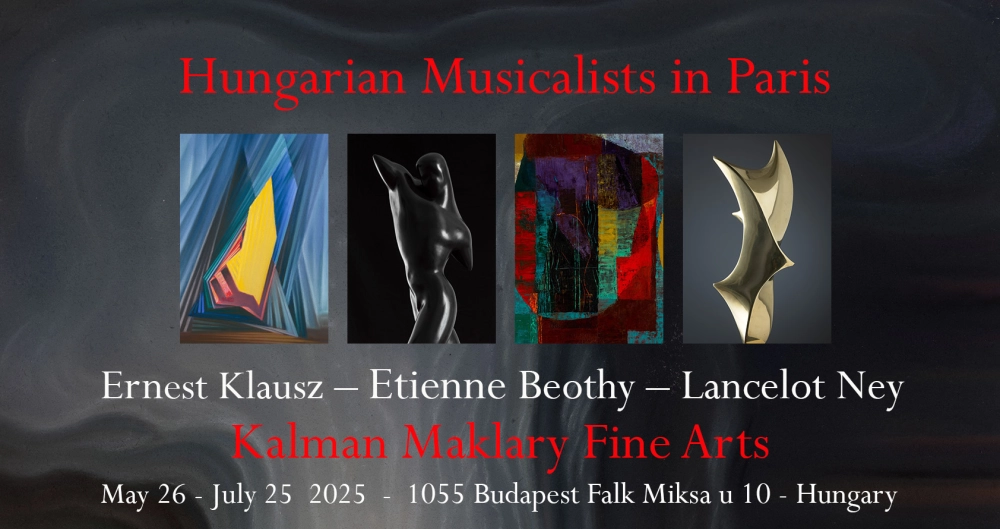
Magyar muzikalisták Párizsban
A „groupe des peintres musicalistes” nevű művészcsoportot Henry Valensi alapította 1932-ben Párizsban. A muzikalisták célja az volt, hogy a zeneszerzés logikáján alapuló módszert alakítsanak ki a képzőművészetben, amely egy olyan absztrakt stílushoz vezetett, mint amilyen a zene maga: nem ábrázoló, hanem érzéki, szerkezetközpontú és ritmikus.
A két világháború között a csoport számos kiállítást rendezett Franciaországban és külföldön egyaránt, köztük 1936-ban Budapesten, a Nemzeti Szalonban. Minden egyes szalon alkalmával új művészek csatlakoztak a mozgalomhoz, köztük Louis Baudon, Jean-Marie Euzet, Georges Filiberti, Arne Hosek, Louise Janin, Ernst Klausz, František Kupka, Marcel Lempereur-Haut, Felix Del Marle, Lancelot Ney, Jean és Joël Martel, Otto Freundlich, Ossip Zadkine és Robert Mallet-Stevens.
A mozgalom három magyar művésze : Klausz Ernő, Beöthy István és Ney László. Ez a kamaratárlat az ő munkásságuk előtt tiszteleg, betekintést nyújtva a muzikalista szemlélet sajátos, harmonikus világába.
Hungarian Musicalists in Paris
The Kálmán Makláry Fine Arts Gallery presents a focused exhibition dedicated to the Hungarian members of the Groupe des Peintres Musicalistes, a pioneering artistic movement that sought to establish a profound dialogue between the visual arts and music. Through the works of Ernő Klausz, István Beöthy, and László Ney, the exhibition revisits a largely overlooked chapter of European modernism while illuminating the significant contribution of Hungarian artists to the intellectual and artistic life of interwar Paris.
Founded in Paris in 1932 by Henry Valensi, the Groupe des Peintres Musicalistes proposed a radical rethinking of abstraction. Rather than approaching painting through representation, its members sought to develop a visual language grounded in the structural principles of musical composition. Their ambition was to create an art that, like music itself, could communicate through rhythm, harmony, movement, and formal relationships rather than through the depiction of the visible world. In this vision, painting became a temporal and sensory experience, where colour, line, and composition functioned as visual equivalents of melody and orchestration.
Throughout the interwar years, the Musicalists organised numerous exhibitions in France and abroad, establishing an international network that extended well beyond Paris. Among their most significant presentations was the 1936 exhibition at the Nemzeti Szalon, which introduced the movement to Hungarian audiences. Each successive exhibition expanded the group's international profile, attracting artists such as František Kupka, Otto Freundlich, Ossip Zadkine, Robert Mallet-Stevens, as well as Louis Baudon, Jean-Marie Euzet, Georges Filiberti, Arne Hosek, Louise Janin, Ernst Klausz, Marcel Lempereur-Haut, Félix Del Marle, Lancelot Ney, and Jean and Joël Martel.
Among this remarkable international community, three Hungarian artists—Ernő Klausz, István Beöthy, and László Ney—played a distinctive role in shaping the movement's aesthetic aspirations. Their works demonstrate how the principles of musicality could be translated into visual form through geometric abstraction, dynamic composition, and an enduring search for balance and proportion.
This exhibition pays tribute to their artistic legacy while offering a renewed perspective on a movement that remains one of the most original yet underexplored experiments of twentieth-century abstraction. More than a historical reconstruction, it invites viewers to rediscover the Musicalist vision as an enduring exploration of the universal relationships between image, rhythm, space, and sound—affirming the place of these Hungarian artists within the broader narrative of European modernism.


