

Emile Lahner - Peter Foldes - Paul Kallos / Hungarian abstract artists from the post war school of Paris
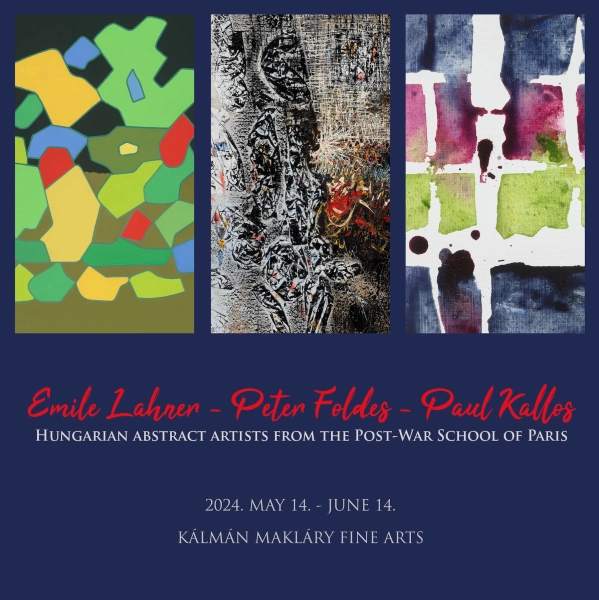
Lahner Emile – Földes Péter – Kallos Pál
Magyar absztrakt festők a második párizsi iskolából
A 20. századi képzőművészet egyik legizgalmasabb története az absztrakció létrejötte. A kreatív felszabadulást, új kísérletezési irányokat hozó látásmód korstílussá válásában elvitathatatlan szerepet játszottak a második párizsi iskola művészei. A II. világháborút követően a francia fővárosban egymás mellett alkotó nemzetközi művészek közösségének történetében ott találunk a 20. század számos nyugatra távozott magyar művészt is. Közülük három alkotó, Lahner Emile, Földes Péter és Kallos Pál eddig ritkán látott műveit állítja ki a galéria. Az egykori Vaszary-tanítvány, a nemzetközi művészeti közegben Émile Lahnerként ismertté vált magyar festő már a két világháború között Franciaországban élt, részt vett a Párizsi Iskola avantgarde irányzataiban, és állított ki együtt Picassóval is. A galéria új kiállításán látható sorozata az színmezők absztrakcióját csendéleteket idéző dekorativitással ötvözi.
Földes Pétert a nemzetközi művészvilág legalább annyira ismeri, mint úttörő animációs-film készítőt, mint festőművészt. A BAFTA, Arany Pálma, César és egyéb díjak sorával elismert magyar alkotó rajzolási készségét már gyerekkorában felismerték, és a világháború végezte el a festő szakot Szőnyi István kezei alatt. Miután 1946-ban elhagyta az országot, megjárta Párizst és Londont is, és festői munkássága mellett a számítógépes animáció jelentős korai alakjává vált. A Kálmán Makláry Fine Arts új kiállításán látható képei lehetnének akár kortárs képek is, amelyek sajátosan ötvözik a lírai színes mélységeket a villanóan gyors grafikai gesztusokból felvillanó vonalazásokkal. A művész korai halála miatt rövidnek számító életművének egyes darabjait magyar közönség még elvétve láthatta. A harmadik kiállított alkotó, Kallos Pál is átélte a világháború boralmait. A haláltábor okozta traumatikus emlékek visszatérően jelennek meg életművében. Abban az időben távozott Nyugatra, amikor a galéria által számos alkalommal bemutatott más művészei is, hiszen személyes ismerőse volt Reigl Juditnak és Hantai Simonnak is. Életművében sajátosan
játszik a figurális és az absztrakt képalkotás határain. Az új kiállításon megjelenő, eddig hazai közönség által így nem látott képei is a látszólagos lírai absztrakció mögötti emlékezet sajátos, személyes hangvételű megjelenítői.
Émile Lahner – Péter Földes – Pál Kallos
Hungarian Abstract Painters of the Second School of Paris
The emergence of abstraction stands among the most compelling developments in twentieth-century art. As a revolutionary new visual language that liberated artistic expression and opened unprecedented avenues for experimentation, abstraction owes much of its evolution to the artists of the Second School of Paris. In the years following the Second World War, Paris became home to an international community of artists working side by side, among whom were many Hungarian émigré painters who made significant contributions to post-war European modernism. This exhibition at Kálmán Makláry Fine Arts Gallery brings together rarely exhibited works by three of these remarkable artists: Émile Lahner, Péter Földes, and Pál Kallos.
A former student of János Vaszary, the Hungarian painter who became internationally known as Émile Lahner had settled in France before the Second World War. As an active participant in the avant-garde circles of the School of Paris, he exhibited alongside artists including Pablo Picasso. The selection presented here reveals his distinctive synthesis of Colour Field abstraction and the decorative sensibility of the still-life tradition, creating compositions of remarkable balance, luminosity, and formal refinement.
Péter Földes is internationally celebrated not only as a painter but also as one of the pioneers of animated filmmaking. Recipient of numerous prestigious honours—including BAFTA, the Palme d'Or, the César Award, and many others—his exceptional artistic talent was recognised in childhood. After the Second World War, he studied painting under István Szőnyi before leaving Hungary in 1946. Dividing his career between Paris and London, Földes developed an equally influential practice in painting and experimental animation, becoming a leading figure in the early history of computer-generated animation. The paintings on view in this exhibition possess a striking contemporaneity, combining lyrical chromatic depth with rapid, gestural linear interventions that animate the pictorial surface. Owing to the artist's untimely death, his oeuvre remained comparatively small, and many of these works are being presented to Hungarian audiences for the first time.
The third artist represented in the exhibition, Pál Kallos, likewise bore the lasting scars of the Second World War. The traumatic memories of his experiences in Nazi concentration camps recur throughout his artistic practice, lending his work profound emotional resonance. He left Hungary during the same post-war wave of emigration as several artists long represented by the gallery, including Judit Reigl and Simon Hantaï, both of whom he knew personally. Throughout his career, Kallos explored the fluid boundary between figuration and abstraction, creating a highly individual visual language in which memory, gesture, and form converge. The works presented in this exhibition—many of them previously unseen in Hungary—reveal how seemingly lyrical abstractions become deeply personal meditations on remembrance, history, and the persistence of human experience.
This version follows the tone and style commonly found in publications by leading international museums and galleries, with a curatorial voice appropriate for exhibition catalogues devoted to post-war European modernism.


