

An Enigmatic Hungarian Painter in Paris - Géza Szóbel (1905-1963) a selection from the collection Kalman Maklary
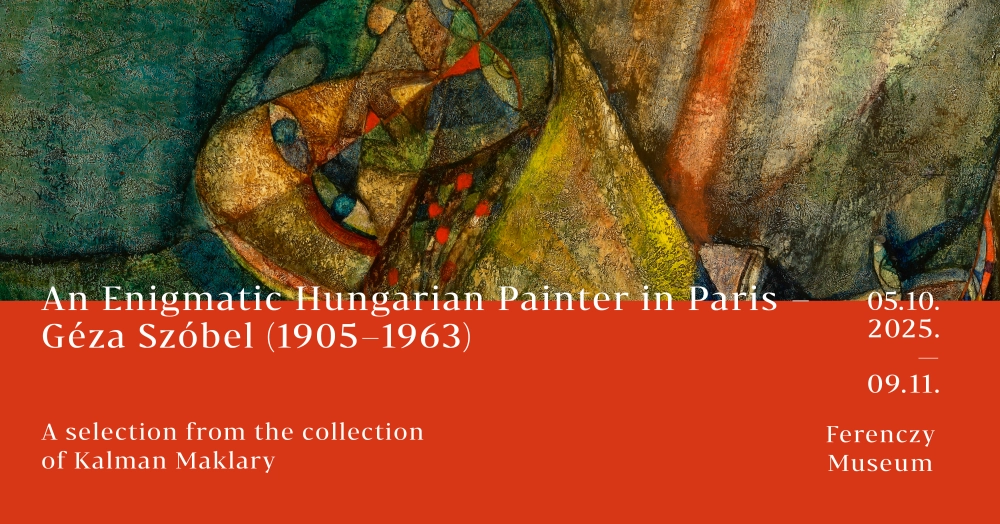
The Ferenczy Museum Centre, Szentendre, in collaboration with Kálmán Makláry Fine Arts, presents a focused retrospective celebrating the 120th anniversary of the birth of Géza Szóbel (1905–1963), the Hungarian-born painter who spent the greater part of his career in Paris.
Born into a Jewish family in Komárom, Szóbel began his artistic education in his hometown before pursuing further studies in Budapest, Berlin, and Prague. By 1928–29 he had already arrived in Paris, then the undisputed centre of the international avant-garde, and in 1934 he settled there permanently. Early in his career he established close ties with both the Surrealists and the artists of the École de Paris, whose ideas profoundly informed his pre-war practice. In 1937 he collaborated, under the direction of Sonia Delaunay, on the execution of the monumental mural commissioned for the Palais de l’Air at the Exposition Internationale des Arts et Techniques dans la Vie Moderne in Paris.The outbreak of the Second World War irrevocably altered the course of his life. For six years Szóbel served with the Czechoslovak Army, first in France and subsequently in Britain. During these years he produced two of his most powerful graphic cycles, Civilisation and Star of David, searing visual meditations on the devastation of war and the persecution of European Jewry. With exceptional emotional intensity, these works confront the fragility, vulnerability, and suffering of humanity. In 1944, every member of Szóbel’s family who had remained in Komárom was murdered in the Holocaust. After the war, the artist never returned to his native country. In the post-war decades Szóbel developed an increasingly distinctive pictorial language. His luminous paintings, built through delicate layers of translucent glazes, became progressively richer in colour, more open in structure, and increasingly abstract in conception. Warrior angels, childlike figures, and compositions recalling the radiance of medieval stained-glass windows inhabit an archaic and visionary realm—a symbolic universe poised at the threshold of human creation. From the mid-1950s onwards, the melancholic sensibility that had long characterised his work gave way to a more liberated, dynamic, and increasingly non-figurative visual language. His artistic development, however, was brought to an untimely end: in the summer of 1963, while his final solo exhibition in Paris was still on view, Géza Szóbel died at the age of fifty-eight. Like many émigré artists associated with the Second École de Paris, Szóbel's oeuvre gradually disappeared from public consciousness after his death. By the 1970s his works had become widely dispersed, while his contribution to post-war the Scool of Paris remained largely absent from art historical discourse. A cosmopolitan artist whose life and career transcended national borders, Szóbel ultimately belonged fully to none of the countries that shaped his identity, and consequently received lasting recognition in none of them. It was only in the early twenty-first century that collectors, galleries, and the art market began to rediscover his remarkable body of work. Bringing together works dispersed across public and private collections, this exhibition seeks to reconstruct the chronology of the artist's life and career while reassessing the achievement of one of the most compelling yet overlooked figures of the School of Paris. By returning Szóbel's work to the museum context, the exhibition aims to restore its rightful place within the broader narrative of twentieth-century European art.
The exhibition has been organised jointly by the Ferenczy Museum Centre, Szentendre, and Kálmán Makláry Fine Arts.
A szentendrei Ferenczy Múzeumi Centrum és a Kálmán Makláry Fine Arts Galéria közös szervezésében kisebb életműkiállítással tiszteleg intézményünk Szóbel Géza (1905–1963) magyar származású, Párizsban alkotó festőművész születésének 120. évfordulója előtt.
