
Simon HANTAÏ
French Hungarian


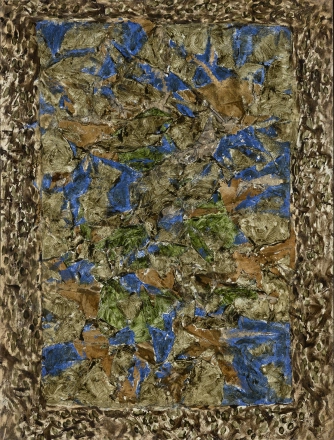
oil on canvas, 46 x 61 cm
"Hantaï’s crumpled and folded paintings created between 1960 and 1982 are also about memory: they recall the mangled, pressed forms of the Swabian aprons of Bia, Duchamp’s rejection of classical painting, the colored shapes of Matisse’s paper cut-outs, and Pollock’s canvases dripped on the floor. A second series of canvases—crumpled and painted in varying formats, using different materials and techniques—was given the title *Catamurons*."
"The oil-on-canvas Catamurons paintings, painted during 1963 and 1964, are actually continuations of the Marian paintings: richly textured, multi-colored, repeatedly painted and folded folds continued to appear on them, with continuous patches of black marks on their base. Some of them, such as the small oil painting Catamurons (1960–1964), were folded and reworked by Hantaï in several passes, thus becoming "Basically: a square within a square." In Catamurons and another small series of oil paintings made by scratching in 1963, Hantaï used the device of 'mise en abyme' to mark the boundaries within the four-sided picture planes.The picture-in-picture motif enclosed the interior of the canvases as a form, and made the frames the basis, or vice versa – the form and the basis became interchangeable, making the difference between them morphologically uncertain. The dark or predominantly white painted edges of Catamurons framed the vertical, rectangular forms, which meant a return to the question of openings that interrupt and divide the plane of the painting. Based on chromatic contrasts and modulations between the folds, the frame of the painting and its other parts, Catamurons asks what is inside their frame. As their title, The Gate, suggests, these paintings are like doors opening onto the depths hidden behind them. In seeking an answer to the question of whether two-dimensional planes have an interior, the pictures shifted the examination of the folds from under the canvas to the space behind it. If the Marian paintings lifted the cloak to show what was beneath them, the Catamurons series cut a doorway in the plane to show what was beyond and within the canvas. In addition to the figurative and metaphorical associations suggested by their titles, the complexity of the examination of spatial relations in the Marian paintings and Catamurons was primarily due to the method used by Hantaï: the paintings examined the modulation of space and plane through the operation of the fold, the emblematic shape of spatial inflection." - Ágnes Berecz, Hantai Vol.II. Published by: Makláry Artworks LTD. 2013, Budapest, Hungary
"Hantai 1960 és 1982 közötti, gyűrt és hajtogatott festményei is az emlékezetről szólnak: a biai svábkötények mángorolt formáira, a klasszikus festészet duchampi
"Az 1963 és 1964 folyamán festett, olaj-vászon Catamurons-képek tulajdonképpen a Máriás-képek folytatásai: gazdagon texturált, többszínű, többször festett és hajtogatott redők jelentek meg továbbra is rajtuk, az alapjukon a fekete jelek folyatott foltjaival. Néhányukat, így például a Catamurons (1960–1964) című, kisméretű olajfestményt Hantaï több menetben is hajtogatta, átdolgozta, így lett belőlük „Alapjában: négyzet a négyzetben.” A Catamurons-ban és egy másik kisméretű, grattázsolással készült, olajfestményekből álló 1963-as sorozatban Hantaï a ‘mise en abyme’ eszközével élve a négyoldalú képsíkokon belül jelölte ki a határokat. A kép a képben motívum a vásznak belsejét, mint alakot zárta körül, és a kereteket tette meg alappá, vagy éppen fordítva – felcserélhetővé vált az alak és az alap, morfológiailag bizonytalanná téve a közöttük lévő különbséget. A Catamurons sötét vagy túlnyomóan fehérre festett szélei keretbe foglalták a függőleges helyzetű, négyszögletes formákat, ami visszatérést jelentett a festmény síkját megszakító és tagoló nyílások kérdéséhez. A hajtások, a festmény kerete és további részei közötti kromatikus ellentétekre és modulációkra épülő Catamurons arra kérdez rá, mi is van a keretükön belül. Mint arra címük a Kapu is utal, olyanok ezek a festmények, akár a mögöttük rejlő mélységekre nyíló ajtók. Arra a kérdésre keresve a választ, vajon a kétdimenziós síkoknak van-e belsejük, a képek a hajtások vizsgálatát a vászon alattiról a mögötte lévő térre helyezték át. Ha a Máriás-képek a palástot fellebbentve megmutatták, mi van alattuk, akkor a Catamurons sorozat ajtónyílást vágott a síkban, hogy megmutassa, mi van a vásznon túl és belül. A címük által sugallt figuratív és metaforikus képzettársítások mellett a térbeli viszonyok vizsgálatának összetettségét a Máriás-képekben és a Catamurons-ban elsősorban a Hantaï által alkalmazott módszer jelentette: a festmények a redő, a térbeli inflexió emblematikus alakzatának működésén keresztül vizsgálták a tér és a sík modulációját." - Berecz Ágnes Hantai Vol.II. kiadó: Makláry Artworks Kft. 2013, Budapest

